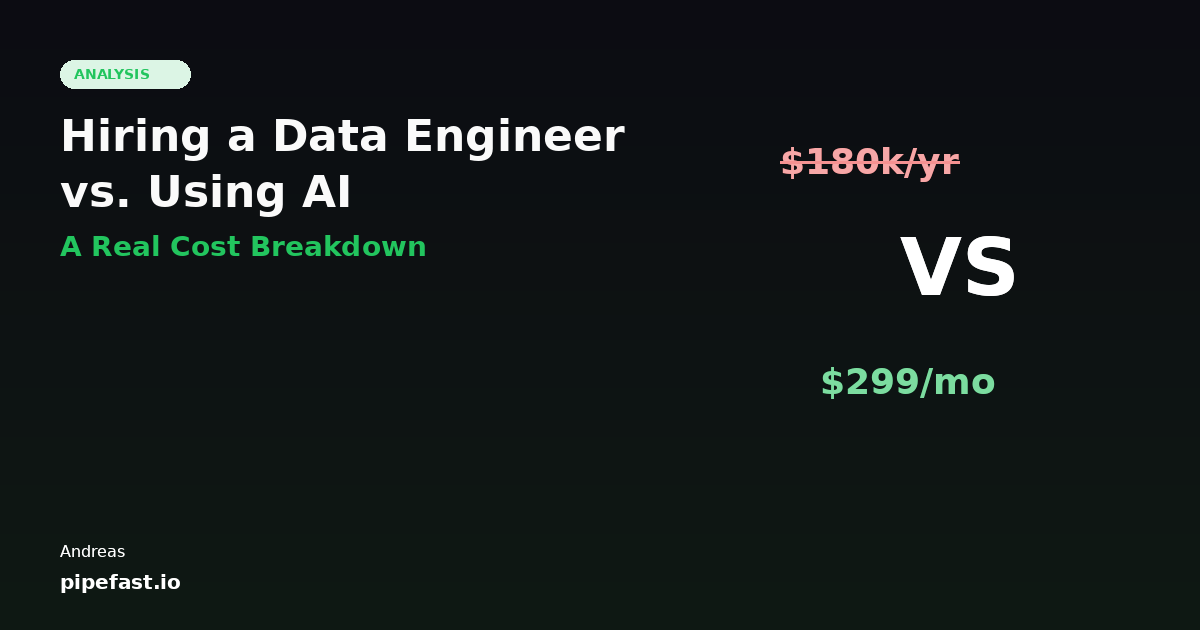
The Real Cost of Hiring a Data Engineer
Everyone knows salary is expensive. But when you run the numbers on what it actually costs to employ someone full-time, the picture gets less comfortable. I've built two companies and hired across different functions — the reality is that base salary is never the full cost.
Here's what you're actually paying for:
1. Salary
Mid-level data engineers in 2026 command $150,000 to $200,000 per year. Senior engineers with real expertise cost $200,000 to $250,000+. Entry-level (and they won't be helpful) might be $100,000 to $120,000. Let's use $175,000 as our median.
2. Benefits & Employment Costs
Health insurance, dental, 401(k) matching, payroll taxes (7.65% for you, 7.65% employee), workers' comp, and unemployment insurance add another 20–30% on top of salary. That's an additional $35,000–$52,500. Conservative estimate: $40,000.
3. Tools & Infrastructure
A data engineer doesn't work alone. They need:
- A data warehouse (Snowflake, BigQuery, Redshift): $2,000–$5,000/month
- Orchestration tools (Airflow, Dagster, dbt Cloud): $500–$2,000/month
- Data connectors (Stitch, Airbyte, Fivetran): $1,000–$5,000/month
- Monitoring & alerting (custom solutions or tools): $500–$1,500/month
- Development environment & version control: $500–$1,000/month
Total: $4,000–$15,000 per month. Let's use $8,000/month or $96,000 per year.
4. Recruiting & Onboarding
If you hire through a recruiter, expect to pay 20–25% of the first-year salary as a placement fee. That's $35,000–$43,750. If you recruit in-house, you're spending weeks of management time. And onboarding takes 3–6 months before your engineer is truly productive. During ramp-up, you're paying full salary for maybe 40–50% productivity. That's another $25,000–$50,000 in opportunity cost.
5. Turnover Risk & Replacement
Data engineers are in high demand. If your first hire leaves (and statistically, they will), you're back at square one. The average tenure for specialized engineering roles is 2–3 years. If they leave after year two, you've lost all institutional knowledge and start over with recruiting costs.
The Real Cost Calculation
| Cost Category | Annual Cost |
|---|---|
| Base salary | $175,000 |
| Benefits & employment costs | $40,000 |
| Tools & infrastructure | $96,000 |
| Recruiting & onboarding | $40,000 |
| Total first-year cost: ~$351,000 | |
| Total ongoing annual cost: ~$311,000 | |
That's a quarter-million dollars per year minimum. And remember — they're one person. They sleep, they take vacation (20 days/year), they get sick, they have bad days. A realistic estimate of actual productive hours for knowledge work is 30–35 hours per week. So you're paying $311,000 annually for maybe 1,500–1,600 hours of actual productive engineering time.
What You Actually Get
One person can realistically build and maintain 2–3 data pipelines per week. That's 100–150 pipelines per year, assuming no vacations or sick days and zero technical debt.
But there's more to the reality:
- They're the only person who understands what they built. If they leave, you lose knowledge. If they get hit by a bus, you're in trouble.
- Pipelines break constantly. APIs change, schema drifts, rate limits get hit. Your engineer is spending 30–40% of their time fixing things instead of building new pipelines.
- They write code that reflects their expertise. A junior engineer produces working pipelines. A senior engineer produces maintainable, documented pipelines. The quality varies wildly.
- Scaling is expensive. When you need two engineers, you suddenly need to pay for team coordination, code review processes, and infrastructure overhead.
The math: $311,000 per year / 100 pipelines per year = $3,110 per pipeline built and maintained.
The AI-Powered Alternative
Now let's look at what you get with an AI-powered data pipeline platform (like Pipefast):
Cost
- Monthly subscription: $200–$500
- Annual cost: $2,400–$6,000
- No hiring, no recruiting, no benefits, no ramp-up time
What You Get
- Unlimited data pipelines (you're not limited by one person's capacity)
- Instant deployment (describe what you want, and the AI builds it in minutes, not weeks)
- 24/7 monitoring and alerting (the platform watches your pipelines 24 hours a day)
- Self-healing (when something breaks, the system attempts to fix it automatically)
- No vendor lock-in (export your code anytime)
- Schema change detection (the platform adapts when your source data changes structure)
The math: $6,000 per year / 500+ pipelines = $12 per pipeline. That's 260x cheaper on a per-pipeline basis.
Real-World Scenario: A $5K/Month E-commerce Company
Let's say you run an e-commerce store doing $60,000 in annual revenue (about $5,000/month). You need to connect Shopify (orders), Stripe (payments), Google Analytics (traffic), and your email marketing tool (customer segments) into one dashboard so you can see revenue by marketing channel every morning.
Option A: Hire a Data Engineer
- Cost: $311,000/year
- Time to first dashboard: 8–12 weeks
- What happens if they quit: You start over
- What happens if you need changes: You're blocked waiting for them to have free time
- Decision: This is financial suicide for a business doing $60K revenue.
Option B: Use an AI Platform
- Cost: $3,600/year (assuming mid-tier plan)
- Time to first dashboard: 5–15 minutes
- What happens if you need changes: You make them instantly
- What happens if the platform goes down: You're no worse off than if your engineer quit
- Scalability: As your revenue grows, you can build more pipelines at zero marginal cost
There's no comparison. For 99% of small businesses, hiring a data engineer at this scale is financially irrational.
When Hiring Still Makes Sense
But here's where I want to be honest: there are situations where hiring a data engineer is the right move.
1. Extreme Scale
If you're running a company doing $20M+ in revenue with complex data infrastructure needs, a single AI platform might not meet your needs. You may need custom solutions, deep integrations, or proprietary logic that no platform offers. At that scale, $311,000 per year for a data engineer is a rounding error.
2. Regulatory & Compliance Requirements
Some industries (finance, healthcare, insurance) have strict requirements around data handling, audit trails, and compliance. You might need an engineer who's HIPAA-certified, SOC 2-trained, or experienced in regulatory frameworks. A general-purpose AI platform might not be enough.
3. Real-Time Requirements
If you need sub-second latency (high-frequency trading, real-time personalization at scale), most AI platforms aren't designed for that. You'll need custom infrastructure that only an engineer can build and maintain.
4. You've Already Hit Platform Limitations
If you've maxed out what an AI platform can do and you're still growing, hire a senior engineer who can extend the platform or build custom solutions on top. By this point, you're scaling fast enough that the investment makes sense.
The Optimal Path: Start with AI, Hire Later
I'd recommend this sequence for most growing companies:
Stage 1: Founder/Bootstrap (0–10 employees)
Use an AI-powered platform. $300–500/month for unlimited pipelines while you're figuring out your data needs. Your main job is understanding the business, not managing data infrastructure. This is the perfect time to move fast without hiring overhead.
Stage 2: Early Growth (10–50 employees)
Still using the platform. You might upgrade to a higher tier ($1,000–2,000/month), but you're still getting better ROI than hiring. Your team is focused on product and sales, not infrastructure.
Stage 3: Scaling (50–200 employees)
This is where you might hire your first data engineer. Not to replace the platform, but to build on top of it. They own data quality, schema management, and custom pipeline logic that the platform can't handle. The platform is still doing 80% of the work; your engineer is optimizing and extending it.
Stage 4: Mature Company (200+ employees)
Now you have a full data team. You might have a data engineer, a data analyst, and a data scientist. The platform is still in use for routine pipelines, but you've invested in custom infrastructure for high-value, complex use cases. Your ROI on engineering is much higher because the volume justifies the cost.
The key insight: Don't buy a ferrari when you need a bicycle. Most small businesses are trying to solve a bike problem with a ferrari, then wondering why it's so expensive.
The Caveat on AI Platforms
I should be clear about what AI platforms can't do (yet):
- Handle extremely complex custom logic (though they're getting better at this)
- Manage real-time data at massive scale (sub-millisecond latency)
- Work with proprietary or legacy systems that have no documented API
- Solve problems that require deep domain expertise (financial engineering, etc.)
- Replace a data engineer for highly specialized work (ML data pipelines, for example)
But for 95% of business use cases — connecting your CRM to your data warehouse, syncing Shopify to your dashboard, combining multiple data sources for reporting — AI platforms are not just cheaper. They're faster, more reliable, and require zero training.
Bottom Line
The decision to hire a data engineer should be based on need, not convenience. If you're a small business (under 50 employees, under $10M revenue), hiring a data engineer is almost certainly overkill. Start with an AI platform. Build your data infrastructure without the overhead of employment.
When you've outgrown the platform — when you're asking it to do things it wasn't designed for, or when your data needs are so mission-critical that any downtime is unacceptable — then hire. At that point, you'll have the scale and resources to justify the investment.
"The data infrastructure you need today costs $200–500/month and deploys in minutes. The data infrastructure you might need in three years costs $300K/year. Don't pay for the second one until you actually need it."
Ready to build data pipelines without the engineering overhead?
Pipefast AI handles data infrastructure automatically. Unlimited pipelines, 24/7 monitoring, self-healing — starting at $200/month.
Join the Waitlist